The Complete Convenience Store Design Process
24+ years in business · 2,500+ completed projects
Building a convenience store from an empty lot — or remodeling an existing space into a high-performance retail environment — is one of the most complex commercial construction projects a developer can take on. You're coordinating architects, civil engineers, mechanical engineers, general contractors, equipment vendors, municipal inspectors, health departments, and fire marshals across a project that typically spans 9 to 18 months from concept to grand opening. Any one of those threads going off the rails delays your entire opening.
JayComp Development runs that entire process as a single, coordinated scope. We've done it 2,500+ times across 24+ years, which means we know what breaks, when it breaks, and how to keep it from breaking on your project. This pillar walks through the exact phases of a convenience store design process, what happens in each phase, and where the common pitfalls hide. Call our team at 877-843-0183 or reach out through our contact page to talk through your project.
Why the Process Matters
Convenience store construction fails when phases aren't properly sequenced. Pour concrete before finalizing equipment specifications, and you discover after installation that the floor drains don't align with the walk-in cooler footprint. Order equipment before the electrical panel is upgraded, and the units arrive weeks before the circuits can power them. Schedule the health department walkthrough before the plumbing is rough-in complete, and the inspector walks away — with a 3-week reschedule.
A professional design process prevents all of this by running phases in the correct order, with the correct dependencies mapped, and with a single project manager accountable for keeping every trade on schedule. The ROI on professional process management is massive — typically shaving weeks off the project timeline and tens of thousands off the contingency budget.
Phase 1: Site Evaluation and Feasibility
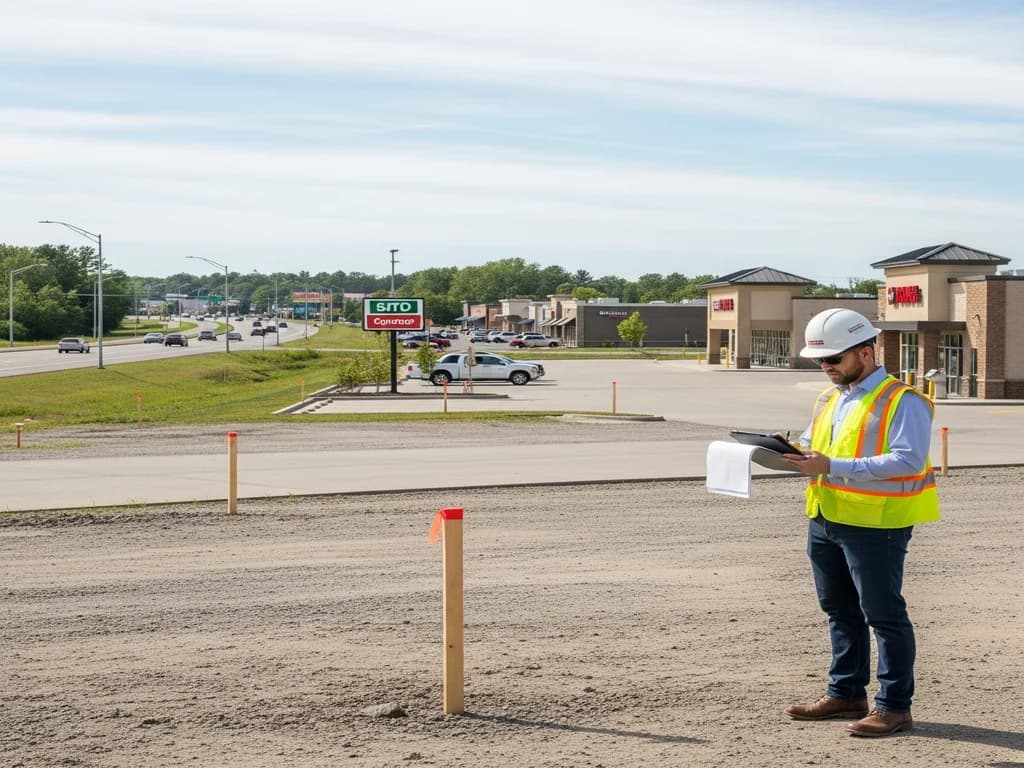
The design process starts before a single line is drawn. We evaluate the physical site, the market, and the regulatory environment to determine whether — and how — a profitable store can be built here.
Typical activities in this phase:
- Traffic counts and demographic analysis — who drives past this site, how often, when?
- Competitor mapping — what convenience stores, gas stations, and QSRs are already in the trade area?
- Zoning verification — is the land zoned for retail/fuel, or will it require a variance?
- Utility availability — water, sewer, electrical capacity, natural gas
- Environmental assessment — Phase 1 ESA for previously-developed sites
- Financial projections — construction cost, operating cost, revenue forecast, ROI
For a detailed breakdown of this phase, see our convenience store feasibility study guide — part of the broader convenience store development pillar.
Common bottleneck: zoning variances and environmental remediation. Both can add months to the timeline if the site has issues that weren't caught upfront.
Phase 2: Architectural Design and Drafting
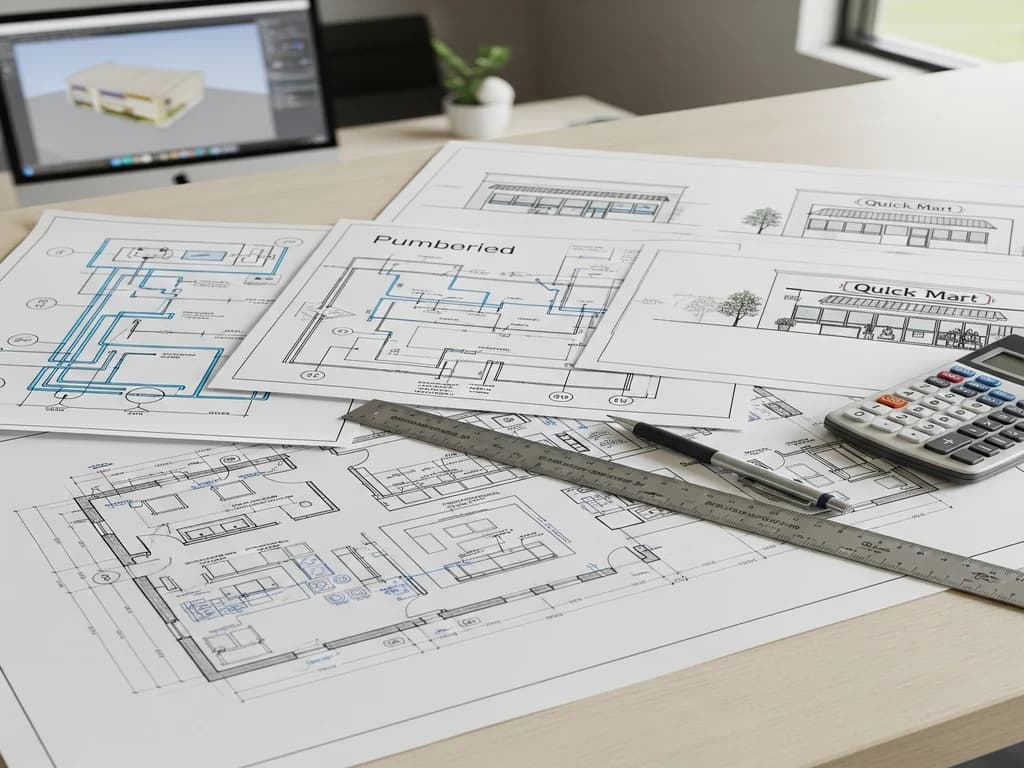
Once the site is confirmed viable, design work begins. This phase produces the complete set of drawings that will govern construction.
What's included:
- Site plans — how the building sits on the lot, parking layout, fuel canopy placement, delivery access, landscaping
- Floor plans — interior layout, fixture placement, food service zones, restrooms, back-of-house
- MEP drawings — mechanical (HVAC, refrigeration), electrical (panels, circuits, lighting), plumbing (water, drainage, gas)
- Finish schedules — flooring, wall treatments, ceiling materials, trim, signage
- Equipment schedules — every piece of equipment with dimensions, utility requirements, cut sheets
For the complete scope of what a design package contains, see our what is included in store design guide.
For the comprehensive breakdown of how long this phase takes, see our convenience store design timeline guide.
Common bottleneck: client-side revisions. Every layout change forces MEP recalculation. Lock decisions early to keep the schedule tight.
Phase 3: Permitting and Municipal Approvals
With the design package complete, permit submissions go out. Convenience stores typically require:
- Building permit (structural, architectural)
- Mechanical permit (HVAC, hoods, refrigeration)
- Electrical permit
- Plumbing permit
- Fire protection permit (suppression systems, alarms)
- Health department sign-off (food service, sanitation)
- Zoning/land-use approval (site plan, signage)
- Environmental permits (if fuel tanks, stormwater)
Review timelines are highly variable — 2 weeks in small rural jurisdictions, 6+ weeks in urban markets. We submit complete, high-quality packages to minimize rejections.
Common bottleneck: municipal backlog and incomplete submissions. Experienced designers draft to local inspector preferences and preempt the most common rejection reasons.
Phase 4: Equipment Procurement
Equipment procurement runs in parallel with permitting because lead times on commercial equipment are long — typically 4–12 weeks for walk-in coolers, Captive Air hoods, and custom millwork.
What happens in this phase:
- Equipment orders placed against the specifications locked in Phase 2
- Vendor coordination across multiple manufacturers (Leer, KPS, Crown Tonka, Heatcraft, Russell, Captive Air, Madix, Royston, and others)
- Delivery scheduling aligned with construction milestones
- Logistics consolidation — centralized staging vs. direct-to-site delivery
Our equipment package process guide covers how we run this phase as a unified scope instead of a piecemeal vendor scramble. For the broader equipment picture, see our convenience store equipment pillar.
Common bottleneck: supply chain delays on specialty items. We track lead times across our vendor network and build in buffer on critical-path equipment.
Phase 5: Construction
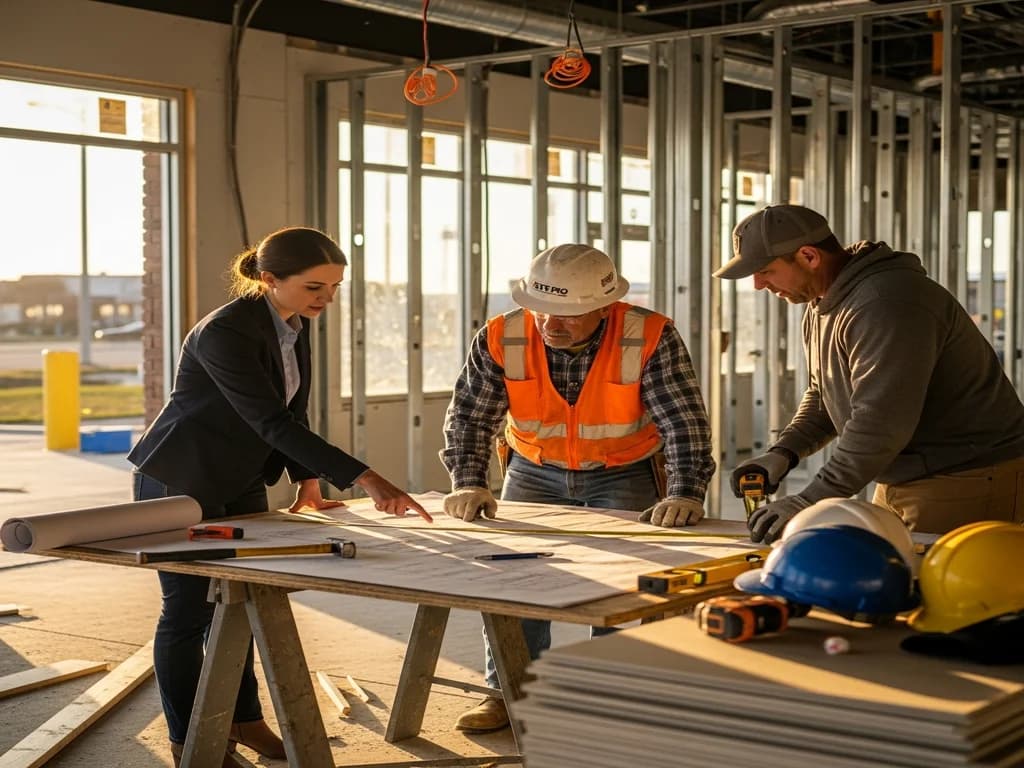
With permits approved and equipment on order, physical construction begins. Typical sequence:
- Site preparation — grading, utilities rough-in, underground fuel tanks (if fuel station)
- Foundation — concrete slab
- Framing — walls, roof, exterior shell
- Dry-in — roof and windows in place, interior protected from weather
- MEP rough-in — electrical, plumbing, HVAC ducting
- Insulation and drywall
- Flooring, wall finishes, ceiling
- Equipment installation — walk-in coolers, hoods, shelving, fixtures
- Final finishes — trim, paint, signage
Coordination between trades is where construction schedules succeed or fail. A single day's delay by one trade cascades into weeks of missed appointments if other trades move on to different sites.
Phase 6: Equipment Installation and Commissioning
Once the shell is built and MEP rough-in is complete, heavy equipment installation begins. Walk-in coolers assemble on site. Commercial vent hoods hoist into position, ductwork welds up, and fire suppression systems wire in. Refrigerant lines run from indoor evaporators to rooftop condensers. POS terminals install at the checkout counters.
Each piece of equipment is installed, tested, and commissioned individually. Our commercial refrigeration services and commercial vent hoods pillars cover the specific processes for these two most technically demanding equipment categories.
Common bottleneck: equipment arriving damaged or incomplete. Our pre-delivery inspection process catches this before installation begins, preventing mid-install discovery that delays everything downstream.
Phase 7: Inspections and Certificate of Occupancy
Before the store can legally open, multiple inspections must pass:
- Building inspector — structural, general code compliance
- Electrical inspector — circuits, panels, service
- Plumbing inspector — water supply, drainage, gas lines
- Mechanical inspector — HVAC, refrigeration integration
- Fire marshal — suppression systems, ductwork, egress; includes puff test on vent hood fire suppression
- Health department — food service sanitation, equipment, handwashing, refrigeration
Passing all inspections results in a certificate of occupancy — legal authorization to open the doors.
Common bottleneck: failed inspections on details the designer or contractor missed. Professional design practices reduce first-try failure rates dramatically.
Phase 8: Merchandising, Staff Training, and Soft Launch
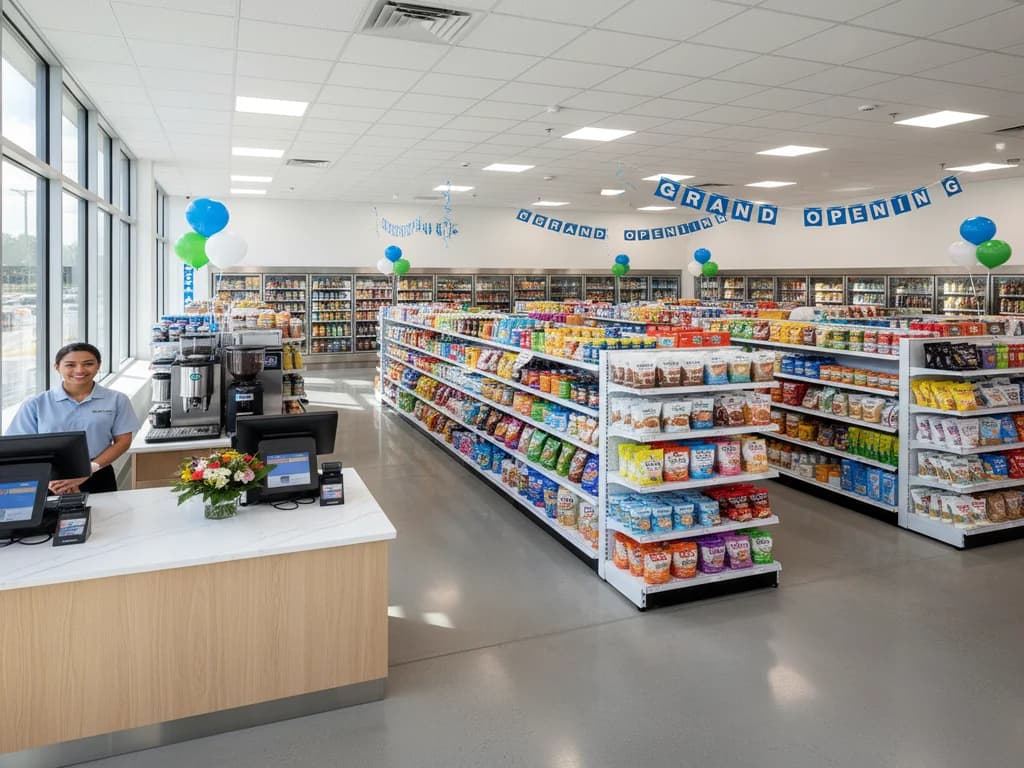
With CO in hand, the store goes from construction project to operating business. Vendors deliver initial inventory. Shelves get stocked according to planograms developed during design. Staff trains on POS systems, food safety protocols, and daily procedures. Most operators run a soft launch — opening quietly for a week or two to work out operational wrinkles before the grand opening marketing campaign fires.
Total Timeline Expectations
A typical new-build convenience store runs 9–18 months from project start to grand opening:
- Site evaluation and feasibility: 4–8 weeks
- Architectural design and drafting: 8–12 weeks
- Permitting: 12–24 weeks (highly variable)
- Equipment procurement: 8–16 weeks (parallel with permitting)
- Construction: 16–24 weeks
- Equipment installation: 3–5 weeks
- Inspections and CO: 2–4 weeks
Remodels typically run faster — 6–12 months depending on scope. Full breakdown in our convenience store design timeline guide.
How the Process Connects to Other Disciplines
The design process is the integration layer where every other discipline plugs in:
- Store design (Pillar 1) — overall aesthetic, layout, and customer experience. See convenience store design.
- Floor plans (Pillar 4) — interior layout drafted in Phase 2. See convenience store floor plans.
- Equipment (Pillar 3) — specified in Phase 2, procured in Phase 4, installed in Phase 6. See convenience store equipment.
- Food service (Pillar 5) — adds complexity to kitchen design, hood specification, and health inspection. See convenience store food service design.
- Development (Pillar 2) — site-level planning, entitlements, fuel infrastructure. See convenience store development.
- Site plans — exterior layout, ingress/egress, fuel canopy. See convenience store site plan.
Our Process Management Approach
Every JayComp Development project runs under one project manager coordinating every trade from concept through grand opening. That manager is your single point of contact for every question, issue, and decision across the 9–18 month project lifetime.
What that unified management delivers:
- Predictable timelines — we've run this process enough times to know realistic schedules vs. optimistic ones
- Early problem detection — we catch issues during design that others catch during construction
- Clean handoffs between trades — one coordinator means no finger-pointing when something goes wrong
- Honest communication — when something does go wrong, you hear about it from us directly, not from a contractor blaming another contractor
Partner With JayComp Development
A convenience store project is too important and too capital-intensive to run as a loose coalition of contractors. You need a unified team that has done this before — specifically for owner-operators building convenience stores and travel centers across the small-to-mid-size portfolio segment.
24+ years in business, 2,500+ completed projects, and an owner-operator-focused approach to every engagement.
Ready to plan your project? Call JayComp Development at 877-843-0183 or visit our contact page.
Where to Go Next
Process deep-dives:
Upstream (pre-design):
Design disciplines:
- Convenience store design
- Convenience store floor plans
- Convenience store equipment
- Convenience store food service design
Specialty installations:
Get a quote
Ready to Plan Your Project?
Call JayComp Development directly at (877) 843-0183, or fill out the form and our team will be in touch. 24+ years of experience, 2,500+ completed projects, and honest guidance on what your project actually needs.
Email: sales@jaycompdevelopment.com
Location: 9310 OK-1 S, Ravia, OK 73455