
The Complete Guide to Convenience Store Floor Plans
24+ years in business · 2,500+ completed projects
Every decision a customer makes inside your store is shaped by the physical layout of the space. The floor plan dictates where shoppers go, what they see first, which merchandise they walk past on the way to what they came for, and how long they stay. Get it right and your average transaction size climbs, your inventory turns faster, and your customers become daily regulars. Get it wrong and you have merchandise nobody sees, aisles that create traffic jams, dead zones where inventory rots, and staff who can't monitor the whole floor from the checkout counter.
JayComp Development has engineered convenience store floor plans across 24+ years and 2,500+ completed projects — every major layout type, every store format, every business model from neighborhood markets to highway travel centers. This guide covers the core floor plan strategies, how to match layout to business model, and the decisions that separate a profitable retail environment from a struggling one. Call our team at 877-843-0183 or reach out through our contact page to plan your project.
Why Floor Plan Optimization Drives Revenue
A convenience store floor plan isn't just a diagram of where shelves go. It's a behavioral engineering document. Every aisle width, fixture height, endcap placement, and sightline decision is a small lever that moves customer behavior in a specific direction.
Well-optimized floor plans deliver:
- Higher average ticket size through strategic impulse merchandising and cross-category placement
- Faster transaction throughput through intuitive queue flow and unobstructed checkout access
- Lower shrinkage through clear sightlines from the register to every corner of the floor
- Improved compliance with ADA aisle widths, health code clearances, and fire marshal egress requirements
- Better staff efficiency — restocking, customer service, food prep all work faster in a well-planned space
The ROI on professional floor planning is one of the clearest in retail: a well-designed layout can easily generate 10-20% more revenue per square foot than a haphazardly arranged store of identical size and inventory.
Core Floor Plan Types
The Grid Layout

The grid layout — parallel gondola aisles running perpendicular to the checkout counter — is the industry standard for convenience stores. It maximizes shelving density, minimizes aisle confusion, and is intimately familiar to shoppers.
When grid works best:
- High-SKU operations that need to maximize inventory on the floor
- Neighborhood markets where customers are doing basket shopping
- Stores prioritizing efficiency over exploration
Key decision points for grid layouts:
- Aisle width (36" ADA minimum, 42–48" recommended for comfort)
- Center-store shelf height (keep low enough to maintain sightlines)
- Destination-item placement (cold vault at the back pulls customers past everything)
The Loop (Racetrack) Layout
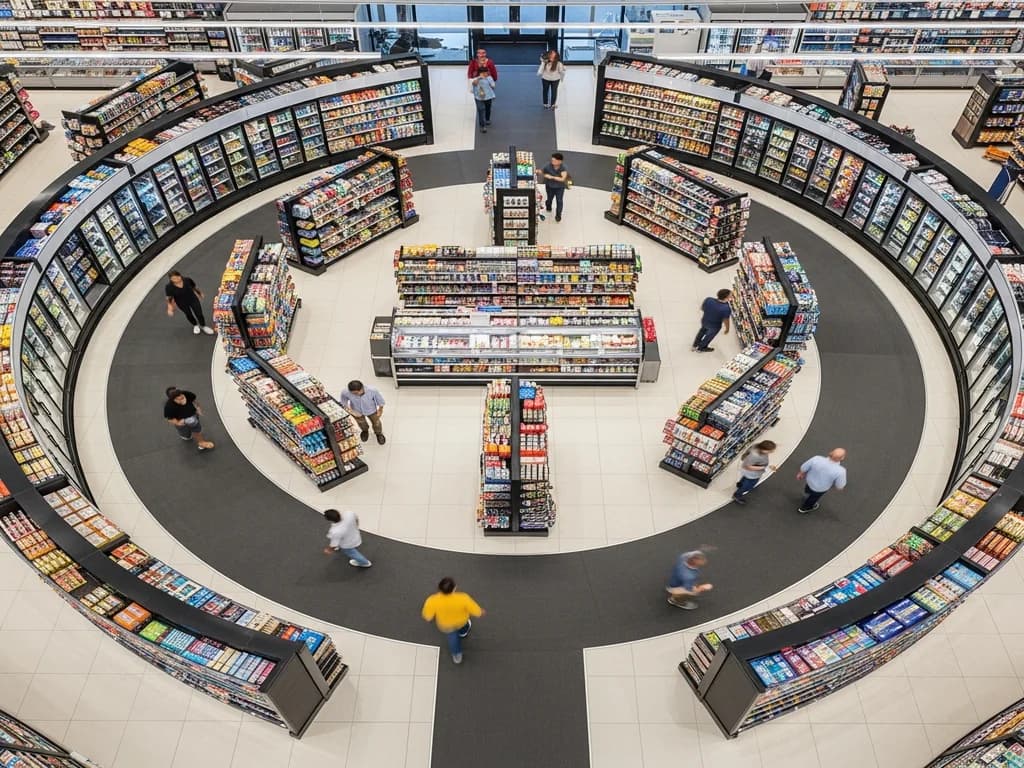
The loop layout creates a defined perimeter pathway that guides customers in a circular flow, with a central island of lower fixtures in the middle. Customers walk past every major department before reaching the register.
When loop works best:
- Stores with strong specialty departments (beer cave, wine section, hot food program)
- Medium-format stores with enough square footage to dedicate center-store to lower promotional fixtures
- Operators focused on driving exploration and impulse purchases
The Angular Layout
Angular layouts abandon rigid parallel aisles for angled fixture placement. Visually interesting, upscale, and excellent for premium retail environments — but sacrifices inventory density.
When angular works best:
- Premium-positioned stores where atmosphere matters more than SKU count
- Urban boutique operations where browsing is part of the experience
The Forced Path Layout
Forced path designs route customers through every section before reaching checkout. Effective for maximum exposure but typically too slow for traditional convenience retail.
When forced path works best:
- Rarely in pure convenience; more common in hybrid specialty retail
For the full decision framework with real-world examples of each layout type, see our convenience store floor plan examples guide.
Matching Floor Plan to Business Model
Convenience Stores With Food Service
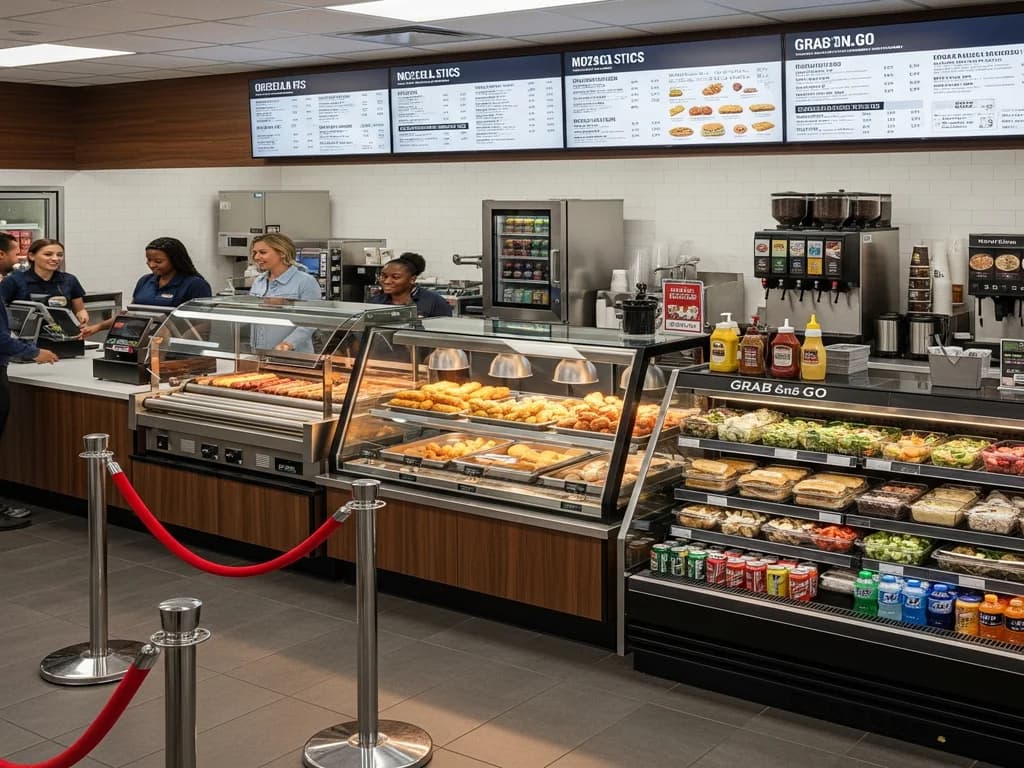
When your operation includes hot food, coffee, grab-and-go, or a branded QSR, the floor plan has to accommodate two distinct customer missions simultaneously: quick-trip retail shoppers and food service customers willing to wait. These two traffic streams cannot interfere with each other.
Key considerations:
- Separate ordering and pickup zones to keep the food queue from blocking retail aisles
- Wide power aisles that split traffic immediately inside the entrance
- Dedicated food service fixtures (roller grill line, beverage counter, hot food display) positioned along natural sightlines from the entrance
- Commercial kitchen layout behind the scenes — see our convenience store food service design pillar
- Vent hood integration for any grease-producing equipment — see our commercial vent hoods pillar
For the full playbook on food service floor plan integration, see our convenience store with food service guide.
Convenience Stores Without Food Service
A retail-only convenience store operates with a fundamentally different floor plan. Without kitchen equipment, ventilation infrastructure, and queue management, every square foot goes to merchandise.
Retail-only stores lean heavily on:
- Maximum shelving density across grid or loop layouts
- Expanded cold vault for beverage sales
- Dedicated specialty zones (automotive supplies, household goods, local products)
- Front-counter impulse merchandising at the checkout
For the specific strategies that make retail-only stores highly profitable, see our convenience store without food service guide.
Liquor Store Floor Plans
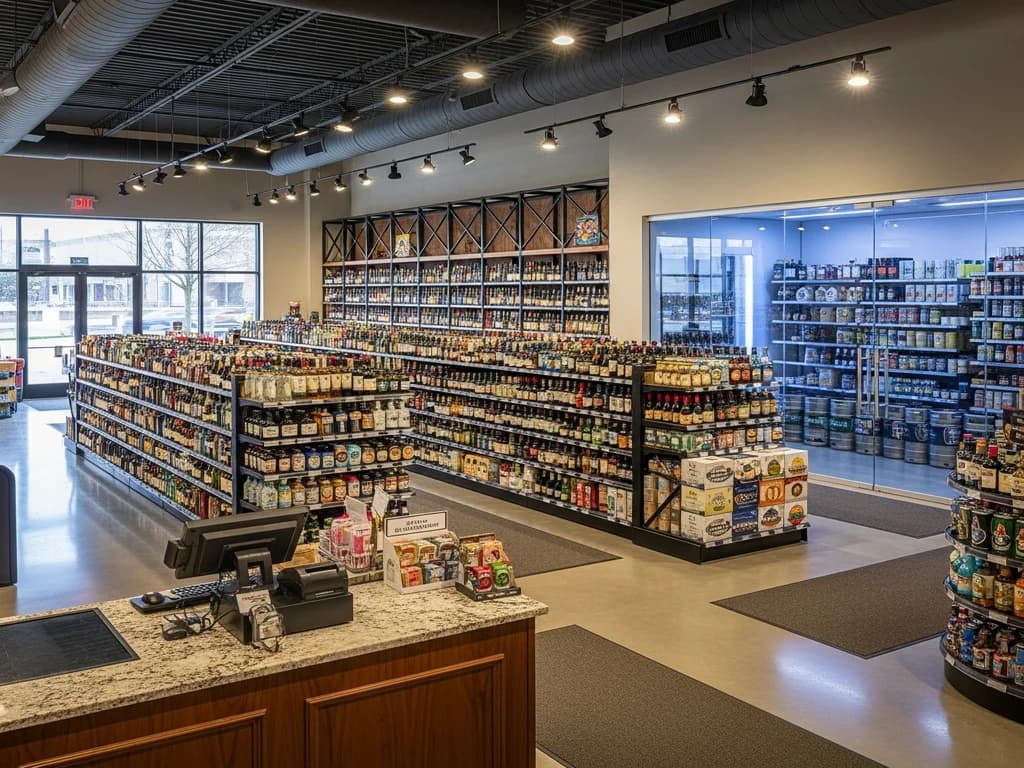
Selling alcohol introduces specific floor plan requirements around security, heavy inventory support, and regulatory compliance. Bottles are fragile and expensive; theft risk is high; aisle widths need to accommodate shopping carts loaded with cases.
Liquor store floor plan priorities:
- Checkout near the entrance/exit so every customer passes staff
- Low center-store fixtures for clear sightlines across the floor
- Heavy-duty reinforced shelving to support case weight
- Beer cave at the back to pull customers past wine and spirits
- Behind-counter displays for premium spirits and high-theft items
Full breakdown in our liquor store floor plan guide.
Common Floor Plan Mistakes
Even experienced operators make layout errors that quietly drain revenue. The most common:
- Blocked sightlines from tall center-store fixtures that hide half the floor from the cashier
- Cramped aisles below 42" that make customers feel rushed and violate ADA in many cases
- Dead zones in deep corners where merchandise never moves because nobody walks there
- Cluttered entrances that block the decompression zone and make the store feel smaller than it is
- Wasted endcaps that sit empty or stocked with slow-moving inventory
- Checkout bottlenecks where the queue spills into retail aisles and blocks other shoppers
Professional floor planning catches these before they're built into the physical space.
How Floor Plans Connect to Other Design Disciplines
Floor plan work sits at the center of the broader convenience store design discipline:
- Store design overall — layout is one element; interior design, lighting, finishes, branding all integrate. See our convenience store design pillar.
- Layout strategy — the psychology and science behind traffic flow: see our convenience store layout guide.
- Small store design — compact floor plans demand their own strategies: see our small store design guide.
- Equipment specification — floor plans dictate what equipment fits and where: see our convenience store equipment pillar.
- Site planning — exterior flow, parking, fuel canopy, and delivery access are all part of the full-property plan: see our convenience store site plan guide and convenience store development pillar.
- Design process — where floor plan work happens in the project lifecycle: see our convenience store design process pillar.
Our Floor Plan Services
We draft convenience store floor plans as part of our full design and development services. The process:
- Site survey — exact building dimensions, structural elements, existing infrastructure
- Business model analysis — what you sell, how customers shop, what your volume looks like
- Layout concept — grid, loop, angular, or hybrid based on fit
- Fixture specification — walk-in coolers, shelving, cabinetry, food service equipment positioned exactly
- Code compliance — ADA, health, fire, and building code integrated into the drawing
- Revision cycles — your input shapes the final plan before we commit to construction
We also manage the equipment procurement, permitting, construction coordination, and final installation that turn a floor plan into an operating store. One project manager, one scope, one accountable partner.
Partner With JayComp Development
Your floor plan is the single most leveraged decision you'll make in a convenience store build. Every other decision — equipment spec, finishes, lighting, branding — operates downstream of where customers can actually walk and what they can see when they do.
With 24+ years in business, 2,500+ completed projects, and a focus on owner-operators rather than corporate fleets, we engineer floor plans that make your specific store profitable — not generic templates applied indiscriminately.
Ready to plan your store's layout? Call JayComp Development at 877-843-0183 or visit our contact page.
Where to Go Next
Floor plan cluster:
- Convenience store floor plan examples
- Liquor store floor plan
- Convenience store with food service
- Convenience store without food service
Design pillars:
Downstream disciplines:
Development side:
Get a quote
Ready to Plan Your Project?
Call JayComp Development directly at (877) 843-0183, or fill out the form and our team will be in touch. 24+ years of experience, 2,500+ completed projects, and honest guidance on what your project actually needs.
Email: sales@jaycompdevelopment.com
Location: 9310 OK-1 S, Ravia, OK 73455