Commercial Refrigeration Services: Design and Installation
24+ years in business · 2,500+ completed projects
Commercial refrigeration is the single largest revenue category in most convenience stores, liquor stores, and food service operations. Cold beverages, beer, grab-and-go food, and frozen inventory drive the transactions that keep the business profitable. When the refrigeration system is specified correctly and installed professionally, that revenue flows cleanly for a decade or more. When it's done wrong, you pay for it forever — spoiled inventory, emergency service calls, sky-high utility bills, and an operation constantly at risk of catastrophic downtime.
JayComp Development specializes in commercial refrigeration design and installation. Not repair. Not service contracts. New installations, replacement projects, and fully-integrated turnkey refrigeration systems for owner-operators building or remodeling convenience stores. 24+ years in business, 2,500+ completed projects, and brand relationships with every major manufacturer that matters — Leer, KPS, Crown Tonka, Heatcraft, Russell, Styleline, Anthony, Commercial Display Systems. Call our team at 877-843-0183 or reach out through our contact page to talk through your project.
Pricing & What Drives Cost
Walk-in coolers from JayComp start around $18,000–$20,000 for compact stock-size cam-lock units (Leer or KPS panel construction, standard refrigeration package, supply-only). Walk-in freezers typically run 30% higher than a comparably-sized cooler due to heavier insulation and low-ambient compressors. Larger custom builds (Crown Tonka, multi-zone, integrated electrical/permits) scale up from there.
Every project is quoted to spec. Actual pricing depends on size, brand, refrigeration sizing, indoor vs outdoor configuration, electrical capacity, permits, and site preparation. The numbers above reflect the smallest standard configuration in our typical commercial product line — they are anchor reference points, not flat rates.
For the full breakdown of what affects your project's quote — every cost driver line-itemed in plain language — see our walk-in cooler installation cost guide. To request a quote on your specific build, call (877) 843-0183 or use our contact form.
What We Do (and What We Don't)
We want to be clear about our focus. JayComp Development is a design and installation firm. Everything we do is about getting new commercial refrigeration systems specified correctly and installed correctly the first time.
We do:
- Design and specify commercial refrigeration for new builds and remodels
- Install walk-in coolers, walk-in freezers, reach-ins, display coolers, and prep tables
- Supply glass display doors from Styleline, Anthony, and Commercial Display Systems
- Coordinate remote condensing unit installation, including rooftop curbs and refrigerant line routing
- Manage permit submissions, inspections, and code compliance
- Deliver complete turnkey refrigeration packages as part of broader c-store development scope
We don't:
- Perform refrigeration repair or emergency service work
- Offer ongoing preventive maintenance contracts
- Provide 24/7 on-call service for running systems
There are excellent local commercial refrigeration service companies in every market. When a system fails, they're the right call. We focus our expertise on the work where it delivers the most value — getting the initial installation right so you have a system worth running for the next decade.
Walk-In Coolers: The Revenue Anchor
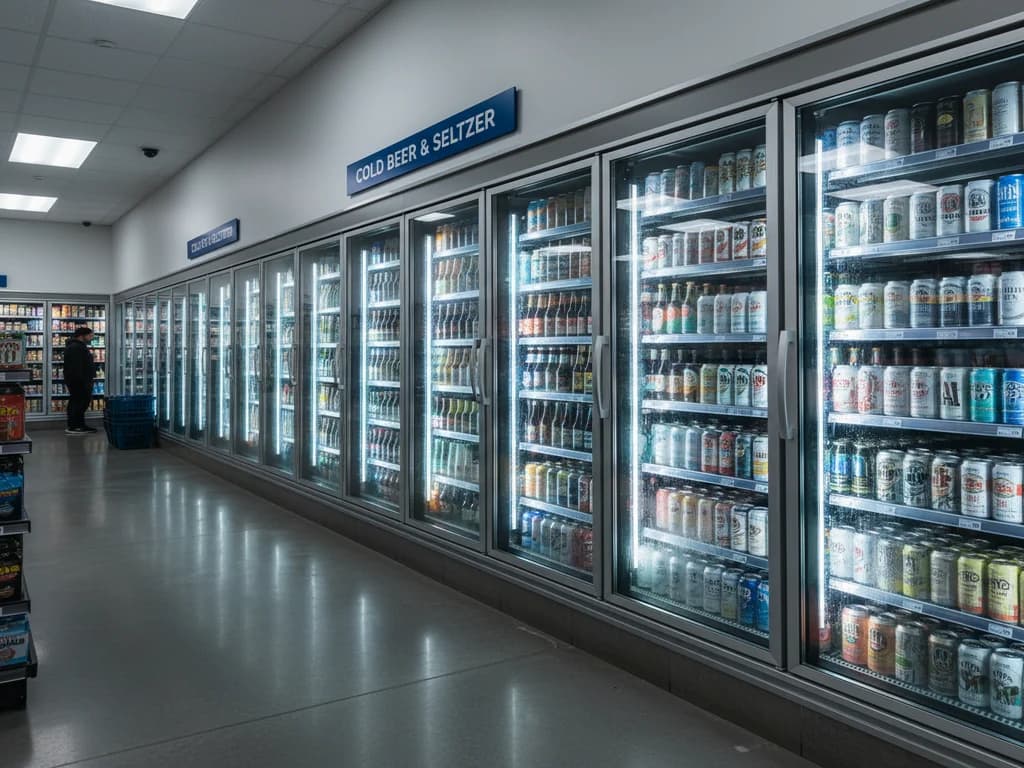
Walk-in coolers are the single largest refrigeration investment in most convenience stores, and the one that anchors your daily beverage revenue. Cold drinks, beer caves, bulk storage for fresh food programs — the walk-in handles all of it.
Manufacturers we specify for walk-in coolers:
- Leer — purpose-built convenience-store walk-in coolers with strong retail-facing configurations. Our default for most c-store beverage applications.
- KPS (Kysor Panel Systems) — custom panel construction for unusual footprints, awkward building geometry, and specialty sizes.
- Crown Tonka — fully custom walk-in designs when off-the-shelf won't fit the use case.
Refrigeration systems we install:
- Heatcraft Refrigeration — medium- and low-temp hermetic condensing units from 0.5 HP to 6 HP, scroll low-temp units single and three-phase, available for same-day shipment.
- Russell Refrigeration — high-performance commercial refrigeration packages.
For the complete walk-in cooler installation process — from site assessment through commissioning — see our walk-in cooler installation guide. For custom pricing variables, see walk-in cooler installation cost.
Glass Display Doors: Where Refrigeration Becomes Retail Sales
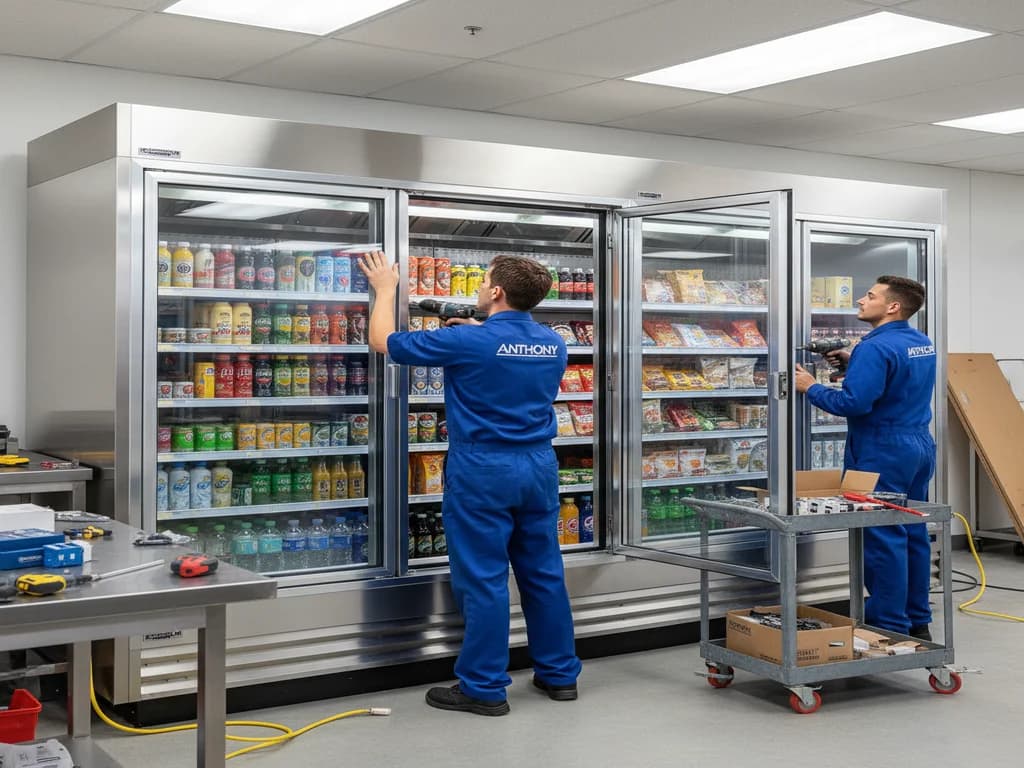
Cold storage only makes money when customers can see and access the product. Glass display doors are the retail-facing surface of your walk-in cooler vault — the line of floor-to-ceiling glass behind which your beer, soda, water, and energy drinks sit bright and cold in front of every shopper who walks in.
The door hardware matters more than most operators realize. A fogged-up, slow-closing, or dimly-lit door kills visual merchandising and costs you impulse sales. Anti-fog double-pane glass, integrated LED lighting, self-closing hinges, and anti-sweat heaters around the frame are all specifications that separate a door that earns its keep from one that drags down your sales.
Glass display door brands we specify:
- Styleline Doors — the industry standard for high-volume convenience store glass door applications. Proven hardware, strong parts availability.
- Anthony Doors — premium merchandiser applications with higher-end finish and performance.
- Commercial Display Systems (CDS) — specialty configurations and custom applications.
Every glass door project we install pairs the right manufacturer to the application. A 12-door beer cave in a high-volume travel center has different demands than a 3-door convenience beverage run — specifying the right hardware matters.
Walk-In Freezers: Sub-Zero Storage Done Right
Walk-in freezers handle the other half of commercial cold storage — sub-zero temperatures for ice cream, frozen food, and long-duration bulk inventory. The engineering is meaningfully harder than a cooler. Thicker insulation, heated door frames to prevent gasket freeze, insulated floors to prevent frost heave, and low-ambient controls on any outdoor unit — all required to operate safely at 0°F or below.
Same manufacturers as walk-in coolers — Leer, KPS, Crown Tonka — plus the Heatcraft or Russell refrigeration system sized for sub-zero performance.
Full breakdown in our walk-in freezer installation guide.
Reach-Ins, Display Cases, and Prep Tables
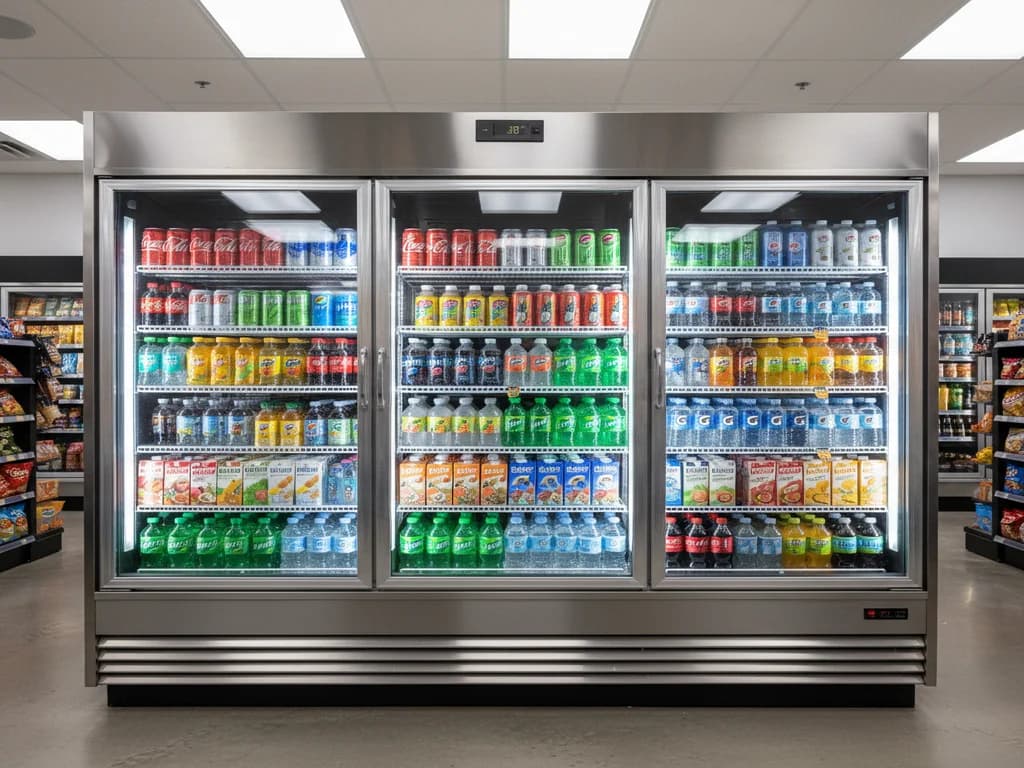
Beyond walk-ins, commercial refrigeration includes reach-in refrigerators for kitchen lines, standalone glass-door merchandisers for smaller beverage displays, refrigerated prep tables for food service, and open-air grab-and-go coolers for fresh food programs.
Each of these has its own installation considerations — leveling, dedicated electrical circuits, condensation drainage, calibration. Mistakes at installation translate to equipment that never holds its rated efficiency.
Full scope of reach-in, display, and prep table installation in our commercial cooler installation guide.
Remote vs. Self-Contained Refrigeration
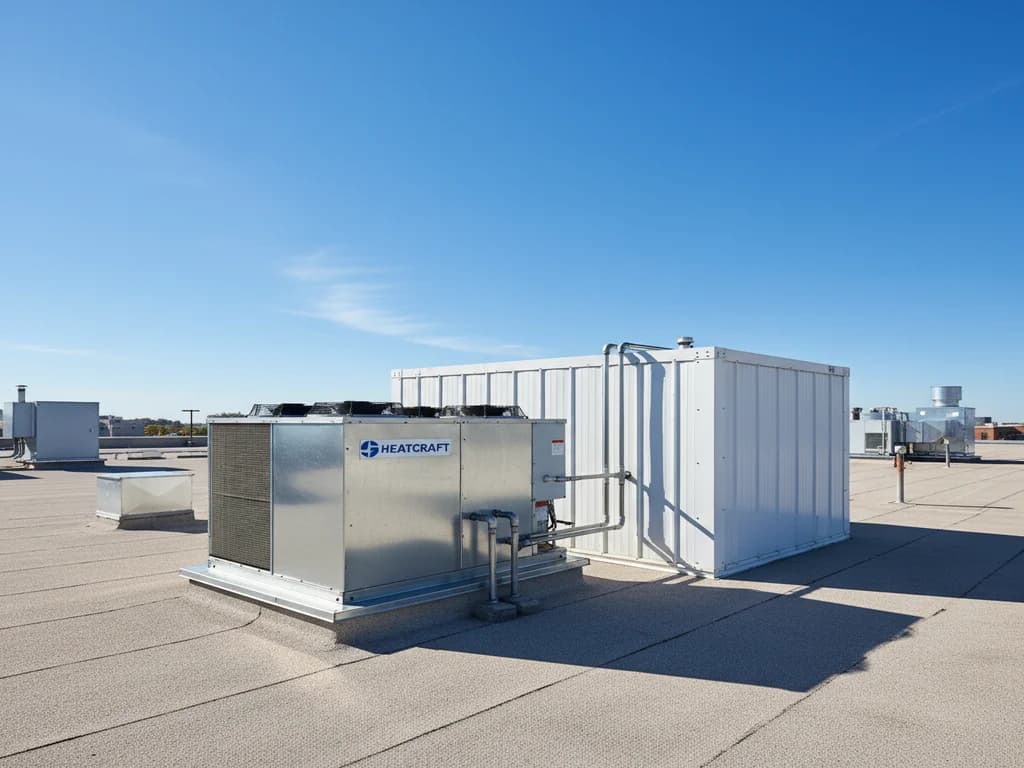
One of the most important decisions in commercial refrigeration design is whether the condensing unit sits on the equipment (self-contained) or remotely on the roof or exterior pad (remote system).
Self-contained systems are cheaper to install but vent hot exhaust and noise directly into your retail space. Your HVAC system then has to work harder to offset the refrigeration heat, which increases your overall building energy bill.
Remote systems cost more up front — more copper refrigerant line, more brazing labor, roof curb and penetration work — but remove the heat and noise from your interior, extend compressor life, and meaningfully lower your total operating cost over the life of the system.
For commercial installations where the cooler runs hard for its full design life, we recommend remote systems almost every time. The long-term economics favor it clearly.
Indoor vs. Outdoor Placement
Where the walk-in itself sits is a separate decision from where the condensing unit lives. Indoor walk-ins are easier to access and protected from weather, but consume interior square footage. Outdoor walk-ins free up interior space but add weatherproofing, concrete pad construction, and low-ambient controls.
Our indoor vs. outdoor walk-in cooler guide walks through the complete trade-off framework.
Requirements and Permits
Commercial refrigeration carries specific site-prep requirements — floor leveling, electrical panel capacity, plumbing for condensation drainage, ventilation clearances — and requires multiple permits before installation can legally begin.
- Site prep details: cooler installation requirements
- Permit scope: permits for walk-in coolers
We manage both as part of every project we install.
Custom Pricing, Not Flat Rates
We don't publish flat-rate pricing on commercial refrigeration. Every project has site-specific variables that move the number meaningfully — size, insulation thickness, compressor horsepower, site prep requirements, electrical upgrades, indoor vs. outdoor, brand specification, and permit costs.
What we do instead is provide transparent, line-itemed custom quotes that explain every variable driving your total. Full breakdown of what affects pricing in our walk-in cooler installation cost guide.
Energy Efficiency: Where Modern Equipment Pays Off
Commercial refrigeration runs 24 hours a day, 365 days a year. That makes it the single largest electricity consumer in most convenience stores — and the highest-leverage place to cut operating costs.
Modern equipment delivers meaningfully better efficiency than units built even a decade ago:
- Higher R-value polyurethane insulation panels
- Electronically commutated (EC) motors on evaporator fans
- LED lighting inside coolers and behind glass doors
- Scroll compressors with variable-speed drives
- Smart digital controllers that modulate system performance against actual demand
Replacing an aging, inefficient walk-in cooler with a modern system often pays for itself in 2–4 years through energy savings alone. Full analysis in our walk-in cooler energy efficiency guide.
When to Replace Rather Than Repair
If you're reading this because an existing unit is failing, we want to be direct. Stretching the life of an aging walk-in cooler through repeated repairs almost always costs more than replacement.
Signals that you've hit the replacement threshold:
- Unit is 10+ years old with recurring temperature issues
- Compressor running near-continuously and still struggling to hold setpoint
- Rising utility bills despite unchanged operations
- Visible panel damage or moisture absorption
- System still uses R-22 refrigerant (phased out, increasingly expensive or unavailable)
- Two or more major service events in the last 18 months
Our walk-in cooler troubleshooting guide walks through the diagnostic signals that indicate end-of-life, and walk-in cooler maintenance covers the routine care that extends usable life on units that still have life left in them.
Our Installation Process
Every commercial refrigeration installation we run follows a consistent sequence:
- Site assessment — structural capacity, floor condition, electrical panel capacity, ventilation, plumbing access
- Design and specification — equipment selection, load calculation, compressor sizing, refrigerant line routing
- Permit submission — building, electrical, mechanical, plumbing, plus health department for food service
- Equipment procurement — coordinated order placement with Leer/KPS/Crown Tonka/Heatcraft/Russell
- Panel assembly — cam-lock fastening, sealed joints, door frame integration
- Refrigeration integration — copper line brazing under nitrogen, pressure testing, deep vacuum, precise refrigerant charge
- Electrical and controls — dedicated circuits, thermostat calibration, defrost timer programming
- Commissioning — temperature pull-down test, compressor amp draw verification, staff handoff
One project manager, one scope, full accountability from start to finish.
How Refrigeration Integrates With the Broader Store Build
Commercial refrigeration doesn't exist in isolation. The walk-in cooler dictates the floor plan. The refrigeration load dictates the electrical service. The condenser placement affects HVAC design. Getting refrigeration specified correctly is inseparable from getting the overall store design right.
- Equipment supply context: convenience store equipment pillar
- Store design integration: convenience store design pillar
- Food service operations: convenience store food service design pillar
- Product catalog: commercial walk-in coolers product page
Nationwide Service Coverage
JayComp Development designs and installs commercial refrigeration and walk-in coolers across all 50 states. For state-specific information on walk-in cooler services, see our walk-in cooler services hub — it links to dedicated pages for each state we serve, covering local code, climate considerations, and trade-area specifics.
Partner With JayComp Development
Commercial refrigeration is the engine of your store's revenue. You can't afford to have it specified by someone who doesn't understand commercial-grade equipment, installed by someone who cuts corners, or designed by someone who's never seen the failure modes we've seen across 2,500+ projects.
We specify Leer, KPS, Crown Tonka, Heatcraft, Russell, Styleline, Anthony, and Commercial Display Systems because they've earned their place through decades of commercial performance — not because we have margin incentives with any one of them. We install to manufacturer spec because cutting corners costs you for the next decade.
Ready to plan your commercial refrigeration project? Call JayComp Development at 877-843-0183 or visit our contact page. We're owner-operator-first, design-and-install-only, and honest about when the math favors replacement over repair.
Where to Go Next
Installation scope:
- Walk-in cooler installation
- Commercial cooler installation — reach-ins, displays, prep tables
- Walk-in freezer installation
Project planning:
- Walk-in cooler installation cost
- Cooler installation requirements
- Permits for walk-in coolers
- Indoor vs. outdoor walk-in cooler
Ongoing operations (educational):
Products:
Nationwide:
Related pillars:
Get a quote
Ready to Plan Your Project?
Call JayComp Development directly at (877) 843-0183, or fill out the form and our team will be in touch. 24+ years of experience, 2,500+ completed projects, and honest guidance on what your project actually needs.
Email: sales@jaycompdevelopment.com
Location: 9310 OK-1 S, Ravia, OK 73455